
How to Centralize Wedding Planning After the Couple Books Your Venue

Once a couple signs the contract and pays the deposit, the real operational work begins.
For many wedding venues, the post-booking phase becomes a maze of email threads, spreadsheets, PDFs, shared folders, vendor documents, floor plan revisions, seating chart updates, and repeated questions. The booking may be complete, but the planning journey is just getting started.
The challenge is not that venues lack tools. The challenge is that planning happens across too many disconnected tools.
If your venue wants to save staff time, create a better couple experience, and uncover new revenue opportunities after booking, centralizing the planning process is one of the highest-impact improvements you can make.
Quick Answer
A centralized planning portal reduces repetitive questions, improves organization, helps venues stay connected throughout the wedding journey, and creates a more polished experience for couples from booking through wedding day.
Best For Wedding Venues
Choose a traditional CRM if your primary goal is managing leads, inquiries, tours, contracts, and sales activity.
Choose Seated With Love if you need a branded couple planning portal that helps manage guest lists, seating charts, floor plans, wedding websites, package selections, planning reminders, registry tools, and couple progress after the booking is complete.
Give couples a planning portal branded to your venue. Start free. Free onboarding included. No credit card required.
The Booking Is Not the Finish Line
Many venue software conversations focus on winning the booking. But most venue operators know the reality is exactly the opposite.
Booking the wedding is often the easiest part.
Before a couple signs a contract, the venue is running a sales process. The team is answering inquiries, giving tours, following up with prospects, and helping couples make a decision. The workflow is relatively straightforward because the goal is clear: turn interest into a confirmed booking.
Once the contract is signed and the deposit is paid, everything changes.
Now the venue is responsible for helping guide months of planning activity. Guest counts evolve. Seating charts are revised multiple times. Floor plans change as details become clearer. Vendors need information. Couples have questions. Deadlines need to be tracked. Documents need to stay organized. What started as a single booking quickly becomes an ongoing operational process that touches nearly every part of the wedding.
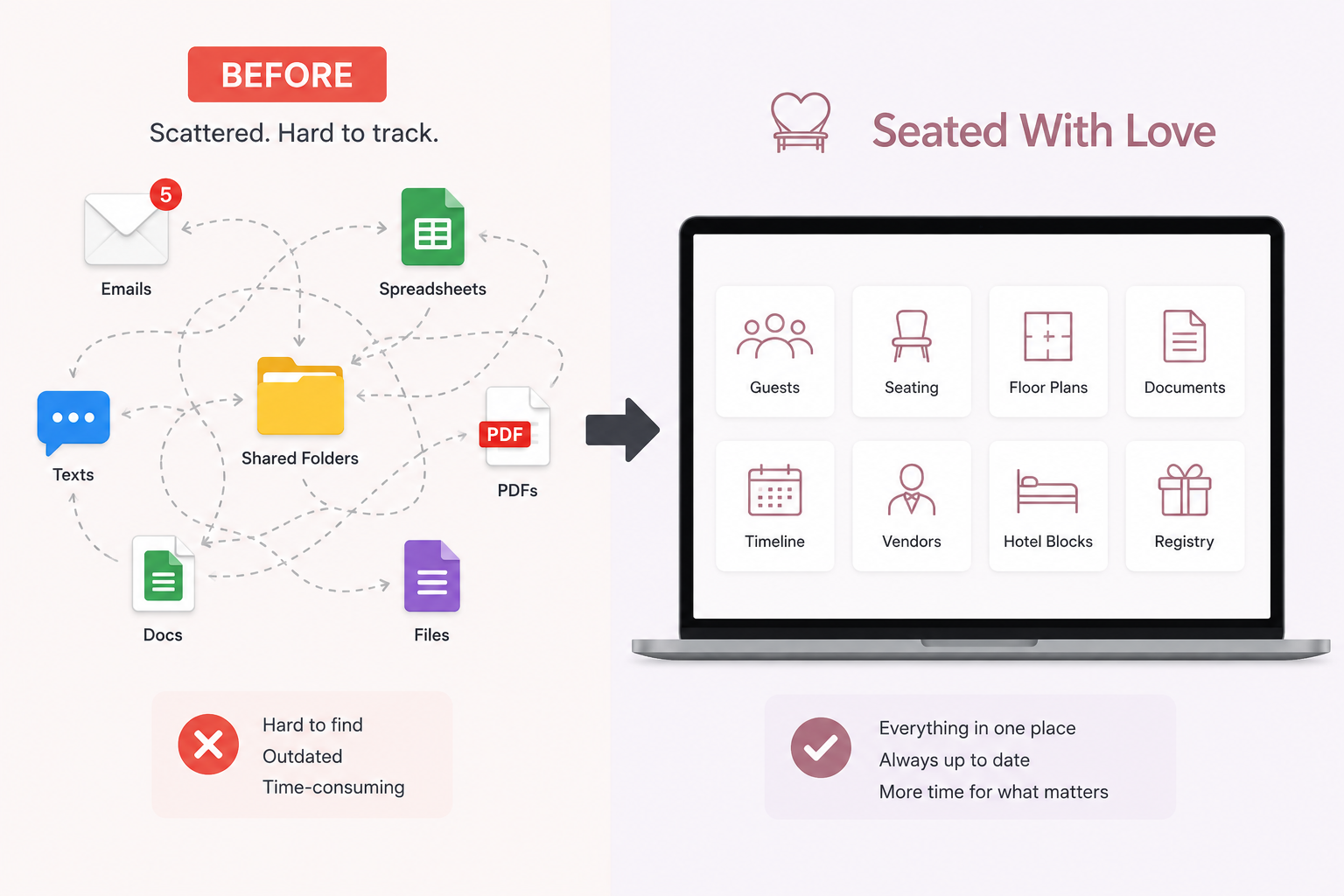
The challenge is that many venues still manage this planning phase across a collection of disconnected tools. A timeline might live in a Google Doc. Seating assignments may be tracked in a spreadsheet. Vendor information could be buried inside email threads. Floor plans are often saved as PDFs and passed back and forth through attachments. Nothing is necessarily broken, but everything is scattered.
When information lives in five or six different places, there is no true source of truth. Staff spend time hunting for answers, couples become unsure where to find information, and small mistakes become much easier to make.
Why Post-Booking Planning Gets Messy So Quickly
The problem is rarely a lack of software. In most cases, venues already have plenty of tools.
Over time, every venue develops its own collection of systems. Email becomes the place for questions. Google Docs become the place for timelines. Spreadsheets become the place for guest counts. PDFs become the place for floor plans. Shared folders become the place for vendor documents. Text messages become the place for urgent updates.
Each tool solves a specific problem reasonably well. The issue is that none of them were designed to work together as a complete planning experience.
| Planning Task | Common Tool |
|---|---|
| Couple communication | |
| Timelines | Google Docs |
| Guest counts | Spreadsheets |
| Seating charts | Separate seating tools |
| Floor plans | PDFs or design software |
| Vendor coordination | Email and shared folders |
| Room blocks | Hotel links and documents |
| Registry information | External websites |
| Reminders | Manual follow-up |
From the couple's perspective, this fragmentation creates uncertainty. They are constantly trying to remember where information lives. Was the room block link sent by email? Is the latest floor plan in the shared folder? Which spreadsheet contains the current guest count? Where did the venue put the planning questionnaire?
From the venue's perspective, the cost is measured in time. Staff repeatedly answer questions that have already been answered. They spend valuable hours tracking down the latest document version. Information has to be copied from one system into another. As wedding dates approach, the risk of missed details increases because there is no central location where everything comes together.
None of these tools are inherently bad. The problem is that the venue and the couple are working without a shared planning home. Every additional platform creates another opportunity for confusion, duplicate work, and unnecessary follow-up.
What Should Be Centralized After a Couple Books?
A true post-booking planning hub should become the place where both the venue and the couple naturally go when they need information.
Communication is often the first area that benefits from centralization. Couples need a reliable place to find planning milestones, due dates, venue updates, package selections, reminders, and answers to common questions. When those details are consistently available, staff spend less time responding to the same inquiries over and over again.
Documents are another major opportunity. Contracts, invoices, vendor requirements, insurance certificates, planning forms, menus, floor plans, and timelines often exist across multiple systems. Centralizing them creates confidence because everyone knows exactly where the latest version lives.
Guest management is equally important. A couple's guest list is constantly changing throughout the planning process. RSVP responses arrive, meal selections are finalized, family seating requests emerge, and table assignments shift repeatedly. Without a centralized system, venues often find themselves comparing multiple spreadsheets just to determine which version is current. A planning hub helps everyone work from the same information and significantly reduces version-control headaches.
Floor plans should also be connected to the planning workflow rather than existing as standalone files. Ceremony layouts, reception configurations, rain plans, vendor placements, and setup notes all influence operational decisions. When floor plans live inside a larger planning system, couples gain clarity while venues maintain better visibility into evolving requirements.
Vendor coordination becomes easier as well. Rather than searching through email chains for contact information, insurance documents, setup times, or arrival schedules, venues can keep those details organized alongside the rest of the wedding information. The result is smoother communication and fewer surprises during the final weeks leading up to the event.
Finally, a centralized planning hub creates natural places for room block information, registry tools, preferred vendor recommendations, decor rentals, and other add-on opportunities that help couples while creating additional revenue opportunities for the venue.
The Difference Between a CRM and a Post-Booking Planning Hub
One of the most common mistakes venues make is assuming their CRM should handle everything.
CRMs are incredibly valuable tools. They help venues manage inquiries, schedule tours, track follow-up activity, monitor conversion rates, and organize sales conversations. For many venues, a CRM is the foundation of the booking process.
The challenge is that booking management and wedding planning management are fundamentally different workflows.
| CRM | Planning Hub |
|---|---|
| Lead management | Wedding planning management |
| Tour scheduling | Guest management |
| Sales follow-up | Seating charts |
| Booking pipeline | Floor plans |
| Contract tracking | Vendor coordination |
| Inquiry conversion | Planning progress |
A CRM tells you who might book. A planning hub tells you what still needs to happen before wedding day.
Many venues ultimately need both systems. The important distinction is understanding that a CRM is designed to help win bookings, while a planning hub is designed to help successfully deliver the wedding experience after the booking is already secured.
What Couples Expect After They Book
Today's couples expect the same level of organization they experience in other parts of their lives.
They can log into their bank account, track a package delivery, manage travel reservations, and access project information from a single dashboard. Naturally, they expect a similar experience when planning one of the most important events of their lives.
What couples do not want is to search through fourteen email threads to find a room block link, a floor plan revision, or an answer to a question they asked two months ago.
A centralized planning portal creates confidence because it gives couples a clear place to go. They know where documents live. They know what deadlines are approaching. They can see how planning is progressing and access important information without waiting for a response from the venue.
That level of organization reflects positively on the venue itself. Even when the physical wedding day is months away, the planning experience becomes part of the venue's reputation.
How Centralization Saves Venue Staff Time
Small venue teams feel every repetitive task.
For an independent venue with one or two people managing weddings, every unnecessary email, follow-up message, and document search has a real cost. Time spent tracking down information is time that cannot be spent preparing for events, supporting couples, or improving the overall guest experience.
One of the biggest misconceptions about software is that its primary value comes from automation. In reality, most venues do not need software to magically run their business for them. What they need is a way to eliminate unnecessary friction. When deadlines are visible, planning forms are easy to find, seating charts stay up to date, and vendor documents live in a predictable location, staff spend less time chasing information and more time acting on it.
Consider what happens during the final month before a wedding. Guest counts are changing, floor plans are being finalized, vendors are asking questions, and couples are looking for reassurance that everything is on track. If every answer requires searching through old emails, opening multiple spreadsheets, or checking several different systems, even simple requests become time-consuming.
Centralization helps because everyone is working from the same source of truth. Couples know where to find information. Vendors know where to access relevant details. Staff can quickly see what is complete, what still needs attention, and where potential issues may exist. The result is not just time savings. It is a calmer, more organized planning process for everyone involved.
How Centralization Creates Add-On Revenue Opportunities
Most couples continue making important planning decisions long after they book their venue. They create registries, reserve hotel blocks, evaluate vendors, purchase decor, explore upgrades, and coordinate countless details that shape their wedding experience.
The challenge for many venues is that these activities often happen outside the venue's ecosystem. Couples leave the venue experience and move into a collection of third-party websites, planning tools, spreadsheets, and vendor platforms. The venue remains responsible for the wedding, but it is no longer part of much of the planning journey.
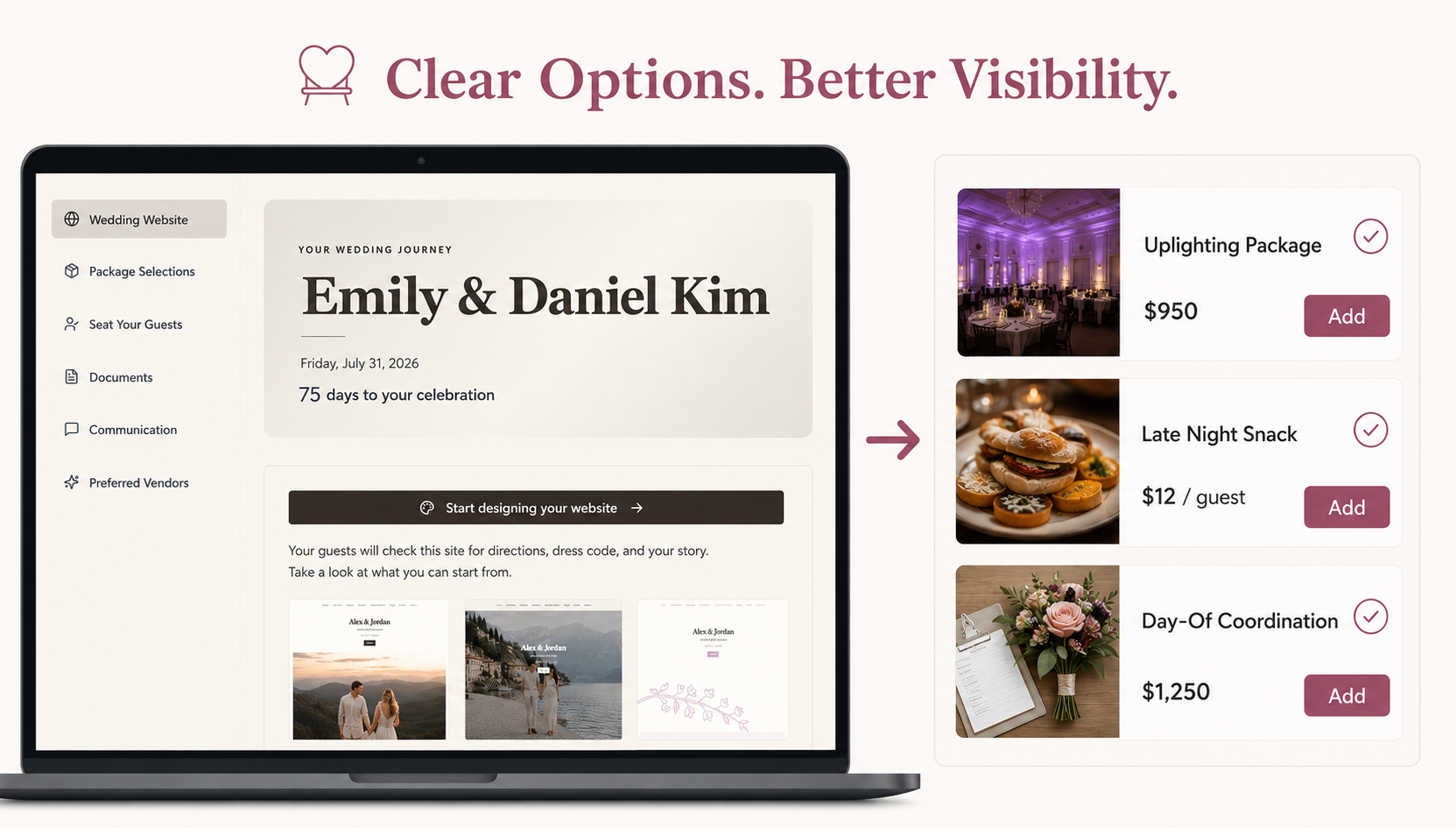
A centralized planning hub creates an opportunity to change that. When couples are already using a venue-branded portal to manage guests, review planning tasks, access documents, and make decisions, there are natural moments to introduce helpful resources and services. Registry tools, hotel accommodations, preferred vendor recommendations, decor rentals, coordination upgrades, and future planning services become part of a cohesive experience rather than isolated promotions.
The key is timing. Couples are far more likely to engage with relevant recommendations when they appear within the planning process itself. A room block recommendation is more useful when a couple is organizing guest logistics than when it arrives unexpectedly in an email. Registry tools are more valuable when couples are actively working through planning milestones than when they are presented as a standalone promotion.
Done thoughtfully, centralization does not make couples feel like they are being sold to. Instead, it helps venues provide helpful resources at the exact moment couples are most likely to need them. The result is a better planning experience for the couple and new revenue opportunities for the venue.
Where Seated With Love Fits
While many platforms focus primarily on lead management and booking workflows, Seated With Love focuses on everything that happens after the contract is signed. It gives venues and couples a shared planning environment where key details can stay organized from booking through wedding day.
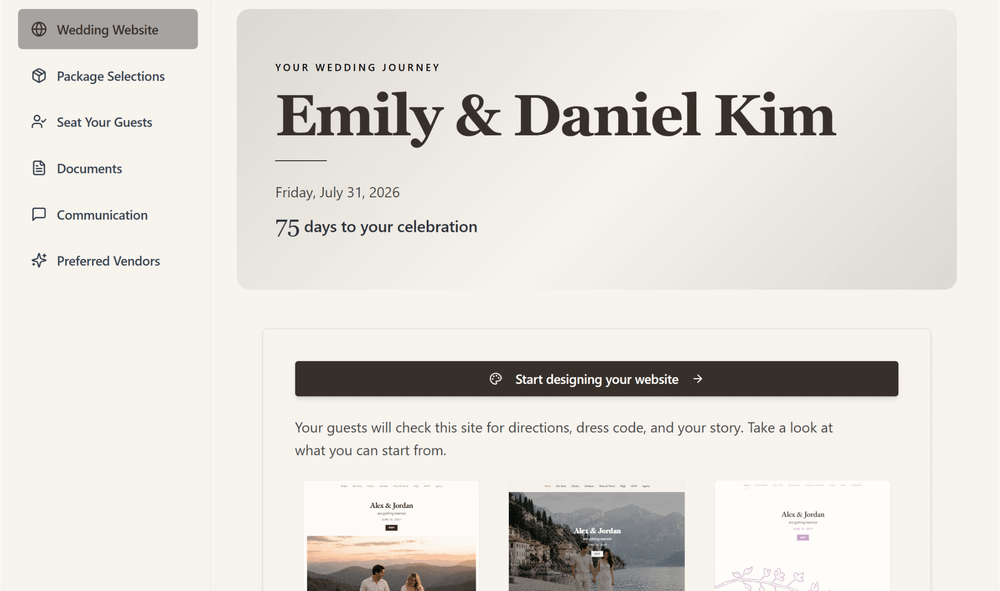
Each couple receives a branded planning portal connected to the venue. Within that experience, couples can manage guests, build seating charts, review floor plans, create wedding websites, access planning reminders, answer venue-specific questions, and stay on top of important milestones. At the same time, the venue gains visibility into planning progress without relying on endless email chains, spreadsheets, and document folders.
For venue teams, this means fewer scattered conversations and better organization. For couples, it creates a more polished experience because they always know where to go when they need information. Instead of piecing together a planning process across multiple disconnected tools, both sides can work from a single shared environment.
Importantly, Seated With Love is not trying to replace every system a venue uses. It is not attempting to be a generic CRM built for every type of business. It is designed specifically for wedding venues that want to centralize planning details, reduce back-and-forth communication, improve the couple experience, strengthen their reputation, and create new revenue opportunities after booking.
Seated With Love is best for independent wedding venues that need a branded couple planning experience after the booking is complete.
Ready to Centralize Planning After Booking?
If your planning process still lives across email threads, spreadsheets, PDFs, and text messages, centralization is often the fastest way to reduce operational complexity and improve the experience for both couples and staff.
Give every couple a venue-branded planning portal with guest management, seating charts, floor plans, wedding websites, package selections, planning reminders, and registry tools.
Start free. Free onboarding included. No credit card required.
A Simple Post-Booking Centralization Audit
Before implementing any new system, it is worth taking a close look at how planning currently works inside your venue.
Ask yourself where couples go today when they need to know what is due next. Consider where vendor information lives, where the most current seating chart can be found, and how room block links or registry details are typically shared. Think about how many different tools a couple touches between booking and wedding day, and how often your team answers questions that should be easily accessible without direct intervention.
Many venues discover that the biggest challenge is not a lack of information. It is that information is spread across too many places. Every additional spreadsheet, email thread, shared folder, or planning tool creates another opportunity for confusion and duplicated work.
The goal of this audit is not to replace everything overnight. Instead, identify the planning surface that creates the most repeated effort. Find the place where information gets lost most often, where questions are repeated most frequently, or where version-control problems occur most regularly. That is usually the best place to begin centralizing.
The 30-Day Roadmap to Centralize Planning
Centralization works best when it is approached as a process rather than a technology project.
During the first week, map your existing workflow. Identify every tool, document, spreadsheet, email process, and communication channel involved after a couple books. The goal is to understand where information currently lives and how it moves through the planning process.
During the second week, decide what your central planning hub should contain. Determine where documents, deadlines, vendor information, guest details, floor plans, and couple-facing resources should live. Establish clear expectations about where information belongs moving forward.
The third week is focused on migration. Begin moving critical planning information into the central hub and organizing it in a way that is easy for both couples and staff to navigate. Prioritize the resources that generate the most questions and the most repeated work.
The fourth week is about adoption. Introduce the hub to newly booked couples and make it part of your standard planning process from the beginning. Centralization only works when people consistently use the system. If couples spend the first several months planning through email, they are unlikely to switch to a portal shortly before the wedding.
The most successful venues make the planning hub part of the booking experience itself. From the moment a couple books, they know exactly where planning will happen and where they should go whenever they need information.
Frequently Asked Questions
What should a wedding venue centralize after a couple books?
A wedding venue should centralize communication, documents, guest counts, seating charts, floor plans, vendor information, timelines, room block links, registry links, and planning deadlines. The goal is to create a single source of truth for both the venue and the couple.
Is a CRM enough for wedding venue planning?
Usually not. Most CRMs are designed to manage leads, inquiries, and bookings. Post-booking planning often requires tools for seating charts, floor plans, guest management, vendor coordination, documents, and ongoing communication.
What is a wedding venue planning portal?
How does centralizing planning save venue staff time?
Centralization reduces repetitive questions, minimizes version confusion, improves visibility, and decreases manual follow-up. Staff spend less time searching for information and more time preparing for weddings.
How does Seated With Love help venues after booking?
Seated With Love helps venues centralize the post-booking planning experience through a branded couple portal that includes guest management, seating charts, floor plans, wedding websites, planning workflows, reminders, and revenue opportunities.
Final Thoughts
The booking is not the end of the wedding journey.
For many venues, it is the beginning of the most operationally demanding phase of the relationship.
When planning lives across emails, spreadsheets, PDFs, and disconnected tools, staff spend more time chasing information and couples feel less supported. Small inefficiencies compound over months of planning and eventually create stress for both the venue team and the couple.
Centralizing the planning experience creates a better experience for everyone involved. Couples gain confidence because they always know where to find information. Venue teams gain visibility because they are working from a single source of truth. Planning becomes more organized, communication becomes clearer, and the venue remains connected throughout the entire wedding journey.
If your post-booking planning process still lives across email threads, spreadsheets, PDFs, and text messages, centralizing it is usually the fastest way to save staff time, improve the couple experience, and create a stronger foundation for every wedding you host.
See how Seated With Love gives your couples and venue one place to plan from booking to wedding day. Start free. Free onboarding included. No credit card required.