
Simplify Vendor Insurance Management with the Right Venue Software!
Managing vendor insurance should not require digging through email threads, folders of PDFs, or spreadsheets just to figure out whose paperwork is still current.
For wedding and event venues, the challenge is not simply collecting vendor documents. It is knowing what you have, what you are missing, and what has expired.
The right venue software can make that process easier by connecting documents directly to vendor records and tracking important dates alongside them.
Seated With Love is venue operations software for wedding and event venues that combines vendor document and expiration tracking with client planning tools such as floor plans, seating charts, questionnaires, guest management, and branded planning portals. For venues managing vendor insurance, Seated With Love keeps COIs and other documents on each vendor record and shows when paperwork has expired.
Key Takeaways
- Vendor insurance management should track documents and expiration dates, not just store files.
- Keeping documents attached to vendor records makes information easier for venue teams to find.
- Expiration tracking helps venues identify paperwork that needs attention.
- Preferred vendors and internal vendor records do not necessarily need to be managed the same way.
- Seated With Love lets venues manage vendor contacts, documents, expiration dates, and client visibility alongside the rest of their event operations.
Start your free Seated With Love portal. Free onboarding included. No credit card required.
What Is Vendor Insurance Management for an Event Venue?
Vendor insurance management is the process of collecting, organizing, reviewing, and tracking insurance documentation associated with vendors working at your venue.
A Certificate of Insurance, commonly called a COI, provides evidence of insurance coverage and generally includes information such as the policyholder, insurer, coverage limits, and policy dates. Depending on a venue's requirements, it may also need to identify the venue as an additional insured or certificate holder.
Venues may also keep other vendor documents on file, including:
- Licenses
- Permits
- Signed agreements
- W-9s
- Other venue-specific documentation
Exactly what your venue requires will depend on your policies, contracts, insurance requirements, vendor type, and local regulations.
But regardless of your requirements, the operational question is the same:
How does your team know whether the paperwork you have on file is still current?
Why Is Managing Vendor Insurance So Difficult?
The hardest part of vendor insurance management is often not collecting a document once. It is maintaining an accurate picture of vendor compliance over time.
In our conversations with wedding and event venues, we have repeatedly heard that the challenge is not simply having a vendor's paperwork somewhere. Venue teams want an easier way to know whose documentation is current, whose has expired, and what still needs to be collected without opening individual files or maintaining separate spreadsheets.
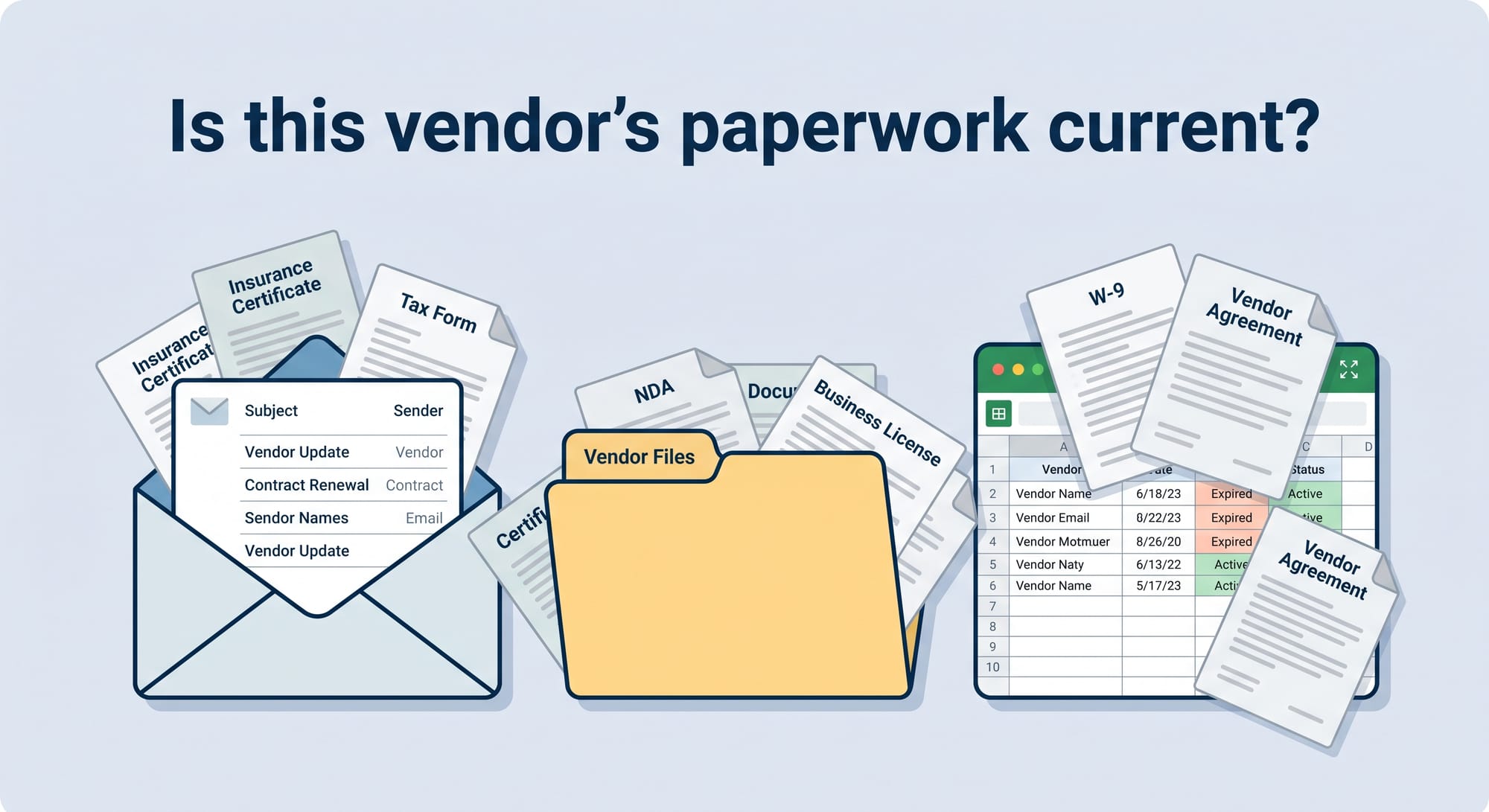
A COI might arrive by email. Another document might be saved to a shared drive. A spreadsheet might list an expiration date but never get updated when a replacement arrives.
Eventually, the venue has plenty of files but no simple answer to a basic question:
Which vendors currently have valid paperwork on file?
A folder can store documents. It cannot necessarily tell you what needs your attention.
What's the Difference Between Document Storage and Vendor Insurance Management?
Document storage tells your venue that a file exists. Vendor insurance management helps your team understand whether the document is still useful and what requires attention.
| Basic document storage | Vendor insurance management |
|---|---|
| Stores a COI or other file | Keeps the document on the vendor record |
| Shows that a file exists | Tracks effective and expiration dates |
| Requires staff to check individual files | Makes expired paperwork easier to identify |
| Documents may be separate from vendor contacts | Keeps contacts and documents together |
| Focuses on storing paperwork | Focuses on what needs attention |
A document-management system answers:
“Do we have a file?”
An expiration-management system answers:
“Can we still rely on the file we have?”
For a venue team managing dozens of outside vendors, the second question is usually much more useful.
What Should Venue Software Track for Vendor Insurance?
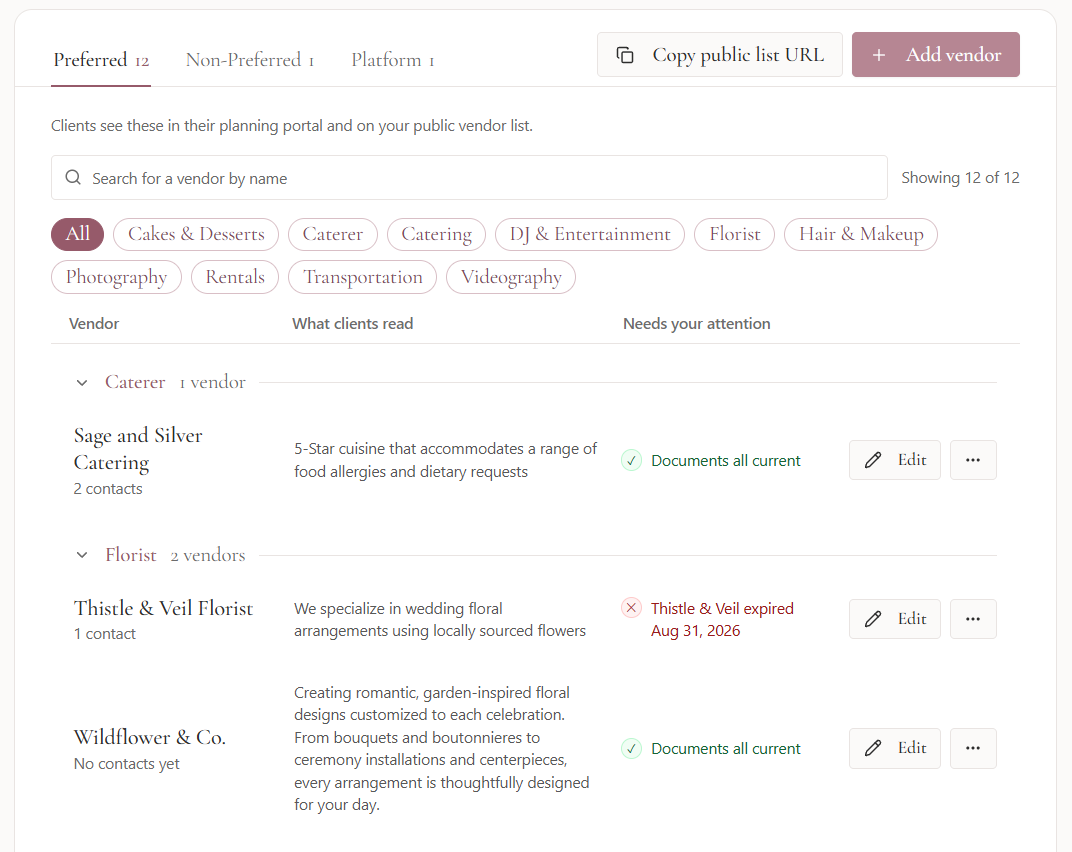
In Seated With Love, venues can keep documents such as COIs, licenses, permits, and signed agreements directly on the appropriate vendor record. Each document can include an effective date and expiration date.
Instead of simply seeing that a file exists, your team can see when paperwork has expired and which document needs attention.
Why Are Expiration Dates More Important Than Document Storage?
A vendor document should not automatically be treated as current simply because your venue has a copy on file.
Insurance policies and many other vendor documents have effective periods. A COI, for example, provides evidence of insurance coverage associated with particular policy dates.
With Seated With Love, effective and expiration dates can be stored with each vendor document. The vendor list can then identify paperwork that has expired rather than allowing an old document to sit quietly in a folder.
For a busy venue team, this changes the workflow from remembering to check to seeing what needs attention.
What Information Should Be Kept on Each Vendor Record?
A useful vendor record should give your team more than a company name and phone number.
With Seated With Love, venues can keep vendor contacts and documents together on one record rather than rebuilding the vendor's history from emails and files.
Venues can also control which individual contact details are visible to clients. Your team might need a specific administrative contact for paperwork, for example, while clients should see the vendor's general business contact information.
Should Preferred Vendors and Internal Vendors Be Managed Separately?
Yes. A vendor your venue needs to keep on record is not necessarily a vendor you want to recommend to clients.
Seated With Love supports two distinct uses for vendor information:
Preferred vendors are businesses your venue chooses to present to clients.
Internal vendor records can be maintained by your team without necessarily being recommended or displayed to clients.
This allows your operational vendor database to be broader than your public recommendations. A venue can keep records for companies that have worked on its property while maintaining a smaller, curated list of businesses it actively recommends.
Why Do COIs Matter for Wedding and Event Vendors?
A COI provides evidence that insurance coverage exists and can show important details such as policy dates and coverage limits.
Specific insurance requirements vary between venues and events, so your venue should establish its requirements with its insurance and legal professionals rather than relying on software to determine whether a vendor is adequately insured.
Venue software serves a different role: organizing and tracking the documentation required by the policies your venue has already established.
Software should make your compliance process easier to manage, not replace professional insurance or legal guidance.
What Happens When Vendor Documents Are Managed Manually?
Manual systems become harder to maintain as a venue's vendor network and event calendar grow.
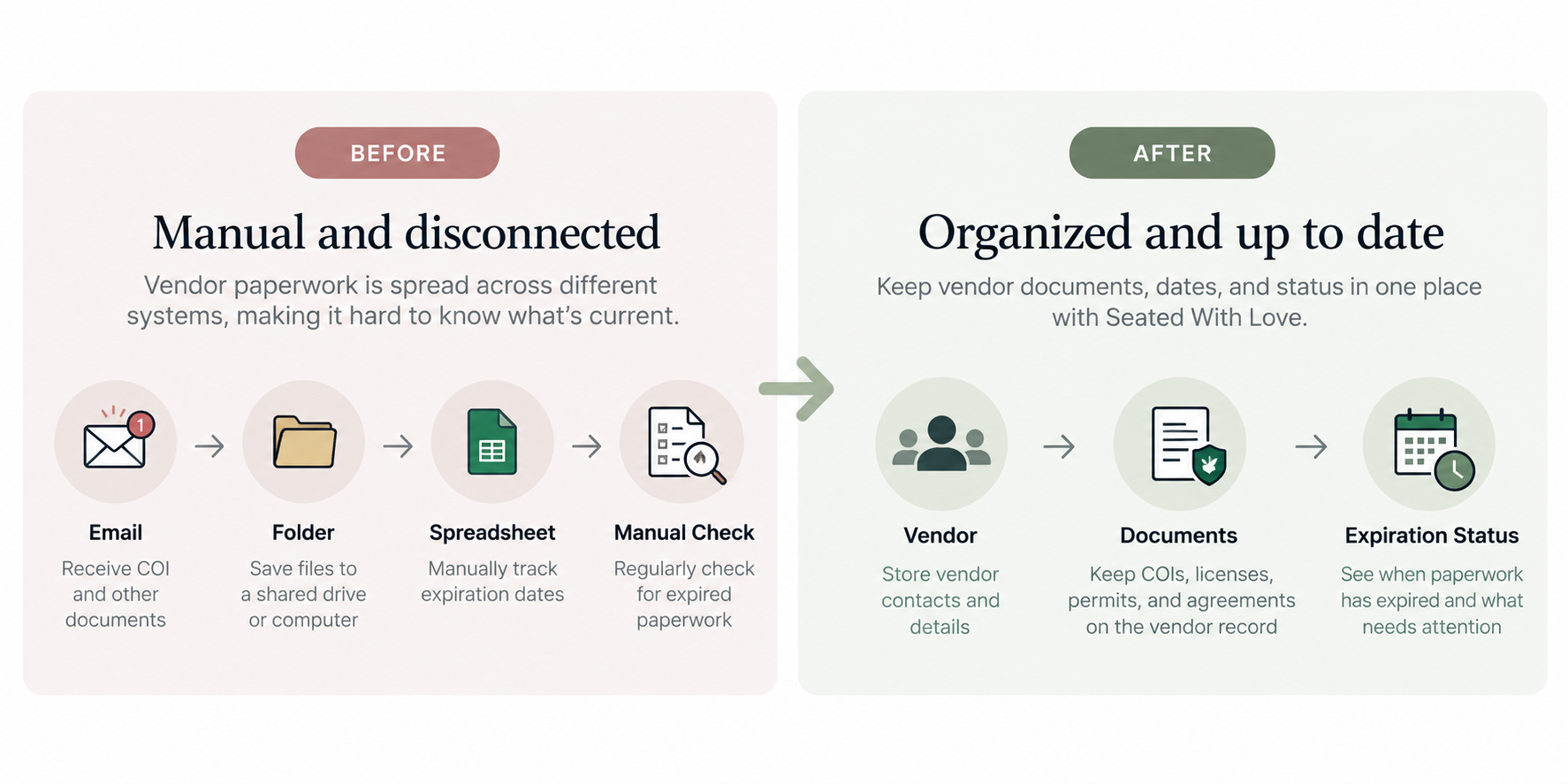
A typical workflow might require a staff member to receive a COI by email, download it, save it in a folder, record its expiration date in a spreadsheet, and later check those systems again to determine whether the document is still current.
The problem is not that any one of those steps is difficult. The problem is that the system depends on people remembering where information lives and when it needs to be checked.
How Can Venue Software Simplify Vendor Compliance?
The best workflow makes vendor status visible during normal venue operations.
Seated With Love gives wedding and event venues a central workspace for client planning, floor plans, seating charts, questionnaires, and vendors.
For vendor documents specifically, venues can:
- Store COIs, licenses, permits, signed agreements, and other documents on vendor records
- Add effective and expiration dates
- See when a document has expired
- Identify vendors with no documentation on file
- Maintain preferred vendors separately from internal vendor records
- Store vendor contacts
- Control which contact details clients can see
Seated With Love is best suited to wedding and event venues that want vendor document tracking to live alongside their broader post-booking event operations rather than in a disconnected file-storage system.
Vendor Management Should Connect to the Rest of Your Venue Operations
Vendor management rarely exists in isolation.
The same venue team keeping track of COIs may also manage floor plans, seating arrangements, questionnaires, guest counts, package selections, and other event details.
Seated With Love is built specifically for wedding and event venues so these workflows can live in the same venue workspace. Clients receive a planning portal branded to your venue, while your team gets visibility into the information needed to prepare for upcoming events.
Vendor documentation becomes another organized part of your venue operations rather than another disconnected system.
A 5-Question Vendor Document Check for Venues
Use this simple check when evaluating your current vendor-management process:
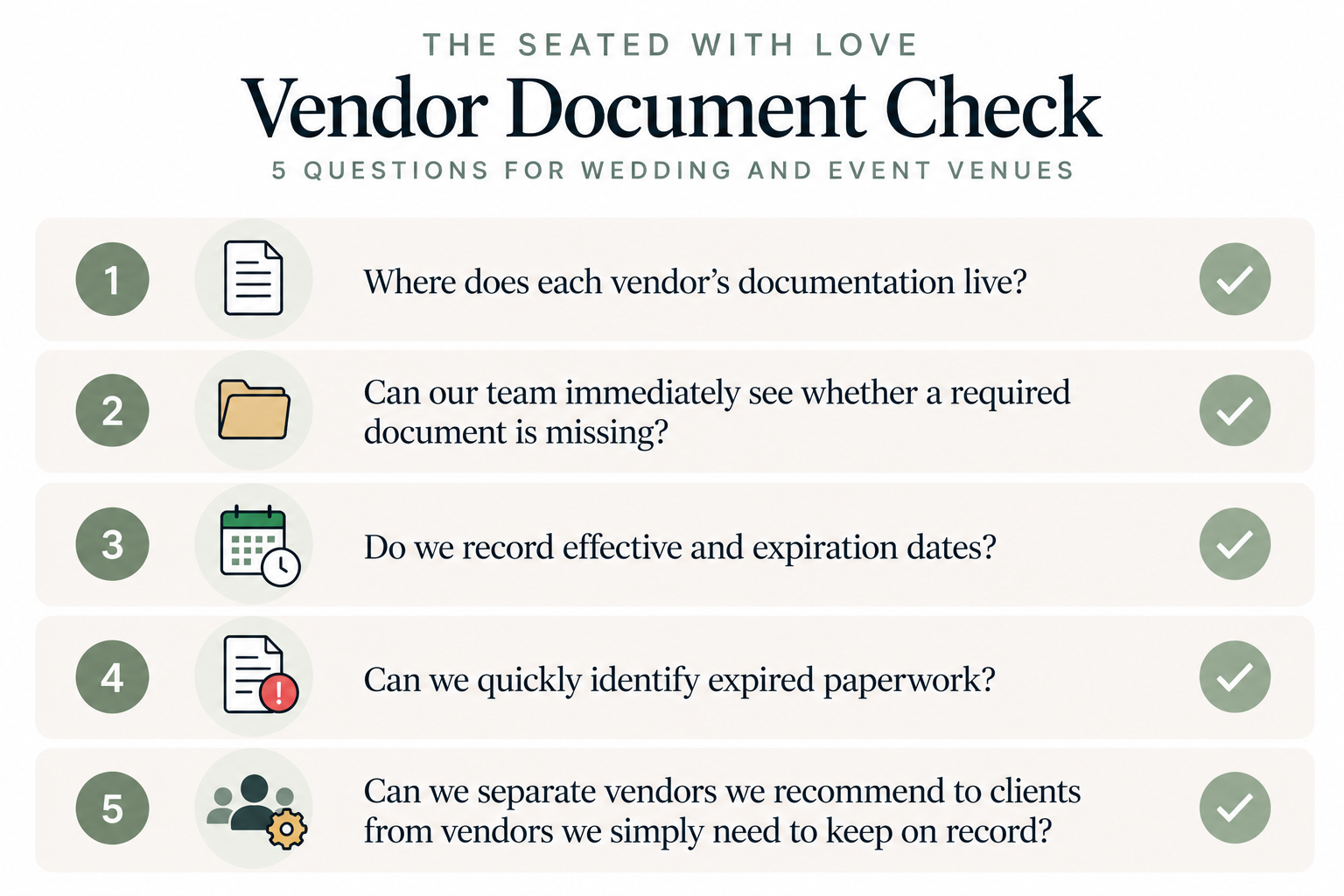
The Seated With Love Vendor Document Check
- Where does each vendor's documentation live?
- Can our team immediately see whether a required document is missing?
- Do we record effective and expiration dates?
- Can we quickly identify expired paperwork?
- Can we separate vendors we recommend to clients from vendors we simply need to keep on record?
If answering those questions requires checking several spreadsheets, folders, inboxes, or staff members, your venue may benefit from centralizing the workflow.
The goal is not to collect more information. It is to make the information you already collect easier to use.
Simplify Vendor Management with Seated With Love
Seated With Love helps venues bring vendor records, documents, contacts, and expiration dates into the same platform they use to manage clients and events.
Instead of wondering whether paperwork has quietly expired, your team gets a clearer view of what is on file and what needs attention.
Seated With Love also includes venue-specific floor plans and seating charts, questionnaires, guest management, branded client planning portals, wedding websites, messaging and reminders, and other tools designed around the post-booking planning process.
Create your free Seated With Love portal and let our team set up your venue for you.
Seated With Love is free to start, requires no credit card, and our team can handle setup for you. Once your venue has five active clients, the Pro subscription becomes $0 per month.
Frequently Asked Questions
What is a Certificate of Insurance for a wedding vendor?
A Certificate of Insurance, or COI, is a document providing evidence of insurance coverage. It typically identifies information including the policyholder, insurer, coverage limits, and effective dates. Your venue's specific insurance requirements should be determined with the appropriate insurance and legal professionals.
Can venue software tell me when a vendor's insurance expires?
Yes, if the software supports document expiration tracking. In Seated With Love, venues can add effective and expiration dates to vendor documents so expired paperwork can be identified from the vendor workflow.
Can Seated With Love store documents besides COIs?
Yes. Venue teams can keep documents such as COIs, licenses, permits, and signed agreements on the vendor records they belong to.
Can I keep a vendor in my records without recommending them to clients?
Yes. Seated With Love separates vendors you recommend to clients from vendors you maintain for your own records, allowing the venue to keep a broader operational database without publishing every vendor.
Does Seated With Love determine whether a vendor meets my venue's insurance requirements?
No. Your venue determines its own insurance and documentation requirements. Seated With Love helps organize the vendor documents and dates associated with the process, but it does not replace advice from your insurance provider, broker, attorney, or other qualified professional.
Is Seated With Love only for vendor management?
No. Seated With Love is venue operations software for wedding and event venues. In addition to vendor management, it includes branded client portals, floor plans, seating charts, questionnaires, guest management, wedding websites, messaging and reminders, and other post-booking planning tools.